USB screens · The driver

// USB screens · setup

USB screens: the driver

SimLogix draws your dashboard straight onto the USB screen of your wheel — no window to capture, whole images at a steady rate, whatever the sim is doing on your monitor. The screen talks to the app over a generic USB driver that Windows does not install by itself. You set it up once, in about two minutes, with a small tool called Zadig.

Start here · 1 min

Is it already done?

If you have used the screen with another dashboard app, the driver may be in place. One look in Device Manager tells you.

Setup · 2 min

Install the driver

Zadig, the right device in the list, WinUSB, Install. Four steps, with what each screen should look like.

Troubleshooting

Screen still blank?

Code 28, a screen that stays black after a race, the wrong USB port — the checks, in the order that finds the cause fastest.

Setup

USB screens

A one-time Windows driver change, and what to check when the screen does not light up. Windows 10 and 11 only — that is where SimLogix runs.

00

What this covers

  • Which screens. The small USB displays built into (or clipped onto) sim racing wheels and dashes, driven by a VoCore-based board. The Cube Controls CSX-3 wheel screen is the one validated on real hardware; other screens of the same family are recognised by their USB identity as they are confirmed.
  • Which USB identity. These screens present themselves to Windows with the USB ID C872 / 1004 (vendor / product). You will match this ID in Zadig and in Device Manager — it is more reliable than any name Windows shows.
  • Not covered. LED strips and shift lights (see the LED guide), and second screens on the network (a tablet or a phone in a browser — nothing to install).
Your wheel keeps working. The screen is its own USB device, separate from the buttons, paddles and LEDs of the wheel. The driver change touches the screen only. Nothing about the wheel itself changes — as long as you pick the right entry in Zadig, which is the whole point of step 2.
01

Is it already done?

If you have used this screen with another dashboard application, the driver is most likely already the right one. Check before installing anything.

  1. Plug the wheel in, open Device Manager

    Right-click the Start button → Device Manager. Plug the wheel (or the screen) directly into a USB port on the back of the PC, not a front-panel port or an unpowered hub — more on that in section 4.

  2. Find the screen

    Look for it in one of two places:

    • Under Universal Serial Bus devices, as a device using the WinUSB driver → you are done, skip to section 3.
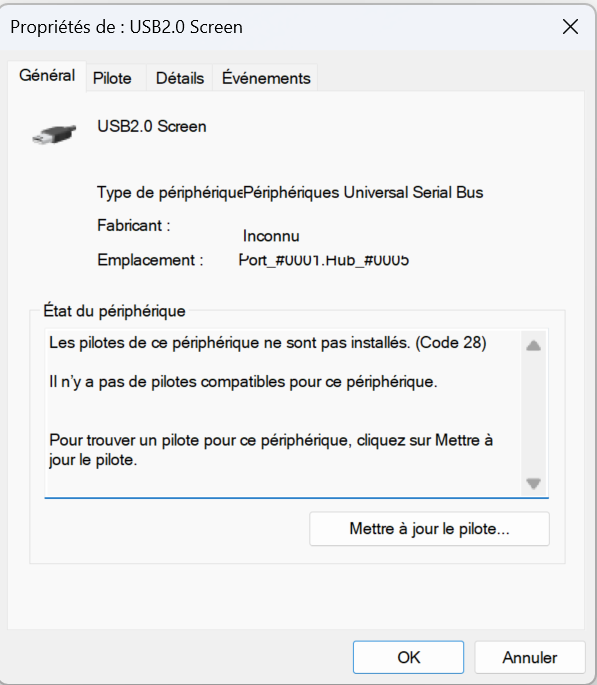
    • Under Other devices, with a yellow warning triangle, as an Unknown device or similar → the driver is missing. Its properties show “The drivers for this device are not installed. (Code 28)”. Continue to section 2.

    Not sure which entry is the screen? Open its Properties → Details tab, property Hardware Ids: the screen reads USB\VID_C872&PID_1004.

    Device Manager — USB2.0 Screen properties: drivers not installed, code 28
    Fig 1. Device Manager — the screen without its driver: yellow triangle, code 28, hardware ID VID_C872&PID_1004.
02

Install the driver with Zadig

Zadig is a small, free, widely used Windows tool whose only job is to bind a generic USB driver to a device. It needs administrator rights and no installation.

  1. Get Zadig

    Download it from its official site, zadig.akeo.ie, and run the executable. Windows will ask for administrator rights — say yes. Leave the wheel plugged in.

  2. Select the screen — and only the screen

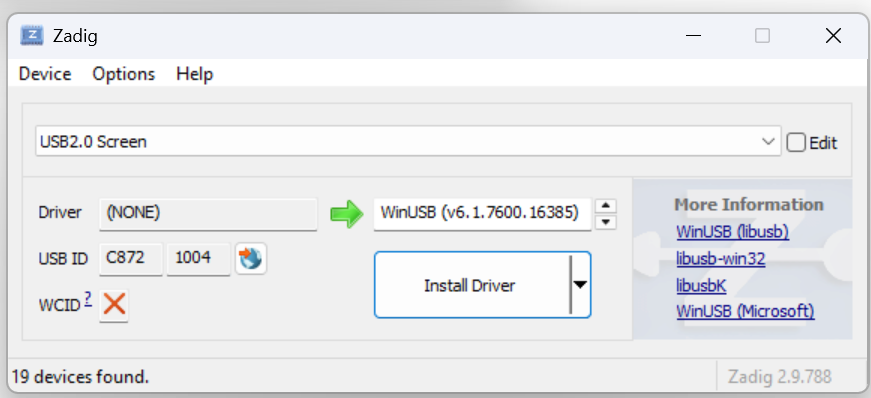
    The drop-down list at the top shows the devices Zadig can act on. If the screen is not listed, tick Options → List All Devices. Pick the entry whose USB ID field (just under the list) reads C872 1004.

    The name Windows gives it varies (it may be a plain Unknown Device, or carry the screen maker's name); the ID does not. Do not select any other entry — the other devices in the list are the wheel's own buttons and LEDs, your keyboard, your mouse. Replacing their driver would break them.

    Zadig — USB2.0 Screen selected, USB ID C872 1004, driver (NONE)
    Fig 2. Zadig — the screen selected, USB ID C872 1004.
  3. Target driver: WinUSB

    To the right of the green arrow, use the small up/down arrows until the target driver reads WinUSB. Not libusb-win32, not libusbK. The field on the left of the arrow shows the current driver — (NONE) on a fresh screen.

    Zadig — USB2.0 Screen selected, current driver (NONE), target driver WinUSB, Install Driver button
    Fig 3. Zadig — target driver set to WinUSB, ready to install.
  4. Install

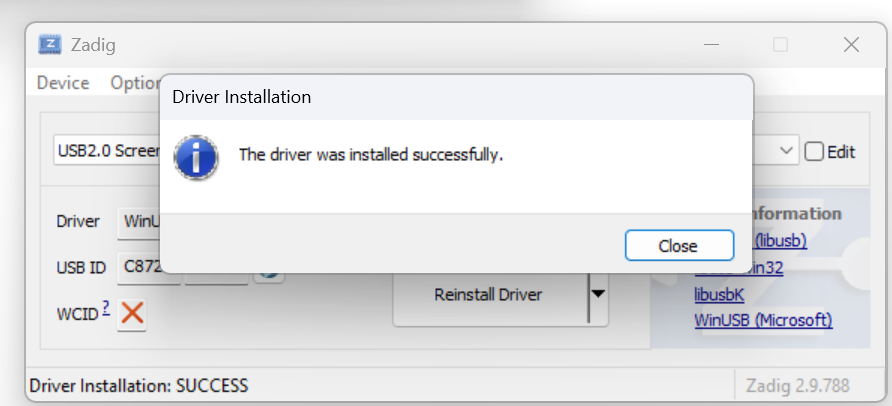
    Click Install Driver (or Replace Driver if one was already there). It takes between ten seconds and a minute; Zadig may look frozen, that is normal. When it reports success, close Zadig, unplug the wheel, wait ten seconds, plug it back in.

    Zadig — Driver Installation: The driver was installed successfully
    Fig 4. Zadig — “The driver was installed successfully.”
Back in Device Manager, the screen now sits under Universal Serial Bus devices, driver WinUSB, no warning triangle. That is the state SimLogix needs.
03

Check in SimLogix

  1. Open the Devices page

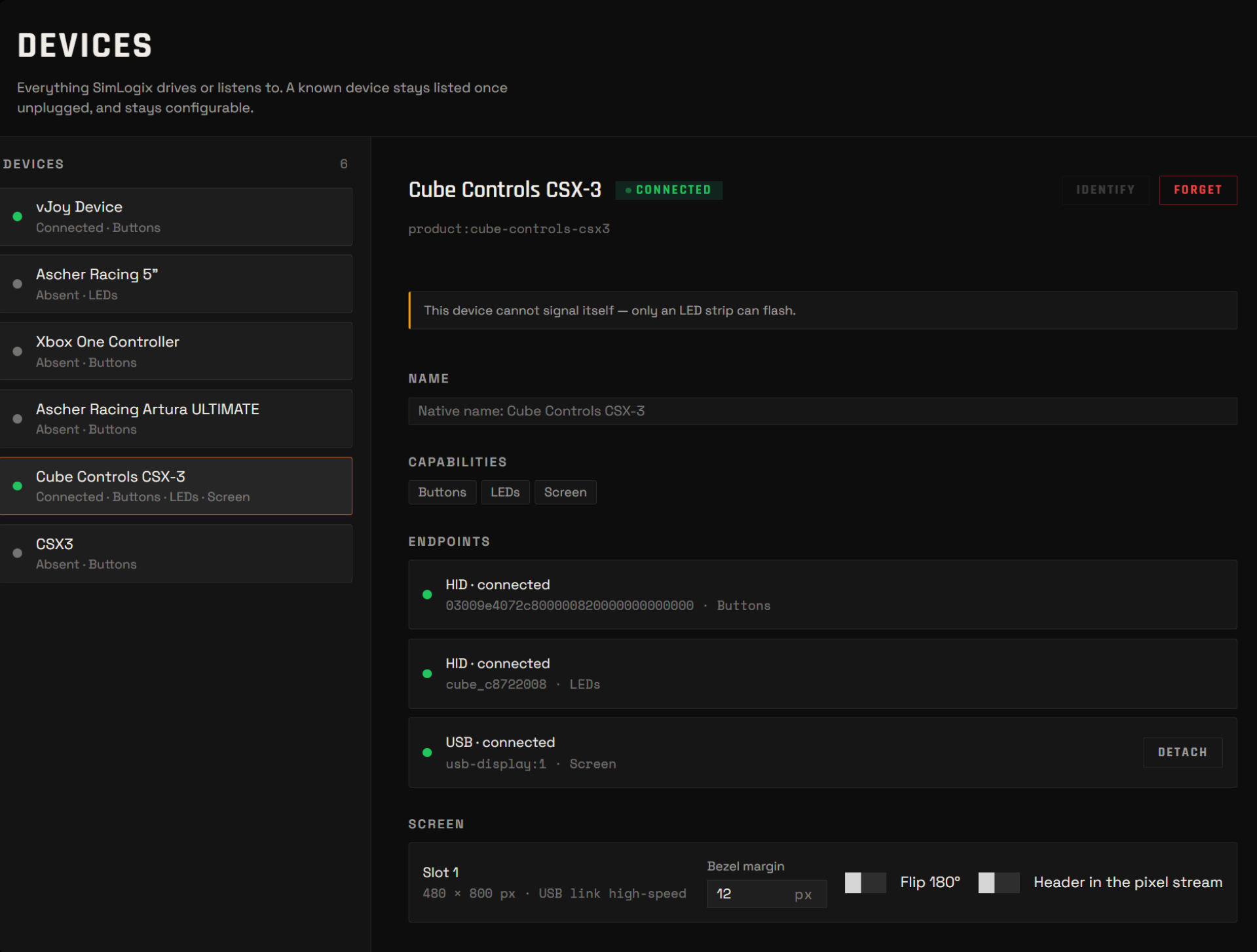
    Launch SimLogix and open Devices. The screen appears in the device rail as soon as the app finds it; select it and its detail panel shows the resolution and the negotiated USB link speed. No sim needs to be running.

    SimLogix Devices page — Cube Controls CSX-3 connected, its USB screen endpoint, 480 × 800 px, USB link high-speed
    Fig 5. The Devices page — the USB screen selected, detail panel showing 480 × 800 px and a high-speed link.
  2. Send it a dashboard

    From Dashboards, launch any preset and choose USB display (VoCore) as its target. The dashboard is drawn on the wheel right away, sim or no sim.

Nothing appears in Devices? Without its driver, the screen is simply invisible to the app — it looks exactly like “no screen plugged in”. The Devices page cannot tell you the driver is missing; Device Manager can. Go back to section 1. (The app log — Settings → About → Logs — does record the refused USB connection, if you want the evidence.)
04

Screen still blank?

In the order that finds the cause fastest.

What you seeLikely causeWhat to do
Yellow triangle, code 28 in Device ManagerDriver missingSection 2.
Screen absent from Devices in SimLogix, but fine in Device ManagerMost often, another program is holding the screen (two programs cannot own it at once)Close other dashboard software that drives the same screen. Replug the wheel, then relaunch SimLogix. Still absent? Ask on Discord with the app log (Settings → About → Logs).
Screen detected, dashboard launched, nothing drawn — or it worked and then froze mid-sessionThe screen has locked up (it does after a bad USB moment — a hub drop, a cable glitch)Unplug the wheel's USB cable, wait ten seconds, plug it back in. A software restart is not enough: the screen can stay listed by Windows and still be dead until it loses power.
Devices shows the link as full-speed, or flags it as throttledThe wheel's USB hub negotiated a slow link (front-panel port, long cable, unpowered hub)Move the wheel to a USB port on the back of the PC, with a short cable, no hub in between. Full-speed carries a fraction of the frames: the app drops the ones that do not fit rather than kill the screen, the picture stutters, and Devices tells you why.
Buttons or LEDs of the wheel stopped working after ZadigThe wrong entry was selected in ZadigSection 5 to restore the original driver for that entry, then redo section 2 on the C872 1004 entry only.
Still stuck? Ask on Discord with a screenshot of Device Manager (the screen's entry and its Hardware Ids) and of the Devices page. That is enough to tell the driver case from the hardware case in one look.
05

Going back

To remove the WinUSB binding — or to repair a device you selected by mistake:

  1. Uninstall the device

    In Device Manager, right-click the entry → Uninstall device. Tick “Attempt to remove the driver for this device” (Windows 10: “Delete the driver software for this device”), confirm.

  2. Replug

    Unplug and plug the wheel back in. Windows re-detects the device and installs its default driver again: the original one for a wheel input, none (code 28) for the screen.

06

Why a driver at all

  • These screens are not monitors. Windows has no notion of them as displays; they receive images as plain USB bulk transfers. To send those, an application needs direct access to the USB device, and on Windows that access goes through a generic driver — WinUSB, shipped with Windows but only bound to a device when someone asks for it.
  • Why it is manual. Binding a driver to a device is a system operation with administrator rights, so it is done once, by you, outside the app. Other dashboard software that drives these screens goes through the same generic driver, which is why the binding may already be there.
  • Why the app does not do it for you. SimLogix does not touch drivers, ever: you know exactly what changed on your machine, and how to undo it (section 5).
  • What the app does with it. It renders your dashboard itself and pushes whole frames to the screen over that driver. Details for the curious are in the dev notes of the repository.